Our writers test and research products independently. When you buy through a link on our site we may earn a commission, but we’ll only ever publish an honest review. Find out more.
Best sterilisers 2026 for baby bottles, breast pumps and more
Whether UV, electric, microwave, cold water or travel sterilisers suit you best, you’ll find tips and top scorers aplenty on this page. Here we reveal the best sterilisers to buy in 2025.
By Rachel Jeffcoat | Last updated Dec 30, 2025
In the hazy days with a new baby, keeping them safe is the number one priority – and also likely to be the biggest source of anxiety for parents. A steriliser can be used to kill bacteria found on lots of different baby feeding equipment like baby bottles, teats and breast pump parts. But which is the best steriliser to make your feeding schedules easier to juggle? After our latest intensive round of testing, we’ve got all the information you’ll need about our favourites.
It's been Mumsnet's mission to make parents' lives easier for over 20 years, so we know how much difference choosing the right product can make. That's why we obsessively research, review and vet everything we recommend - from the best breast pumps to the best changing bags.
Best sterilisers: at a glance
Best steriliser overall: Tommee Tippee Ultra UV Steriliser | £85
£150(-43%)Best steriliser budget buy: Medela Quick Clean Microwave Bags | £10
£13(-26%)Best steam steriliser: Tommee Tippee Super Steam Advanced Electric Steriliser | £40
£75(-47%)Best steriliser you can rent: Bebello Washer 4-in-1 Steriliser | £38 per month, £349 to purchase
Best cold water steriliser: Milton Cold Water Steriliser | £22
Best travel steriliser: Milton Solo Travel Steriliser | £11
Best large steriliser: Dr Brown’s All-in-One Steriliser and Dryer | £110
Best steriliser for drying: Nuby Natural Touch Steriliser and Dryer | £100
How we chose the best sterilisers
We commissioned Rachel Jeffcoat, a writer and mum of three, to research and review the top sterilisers out there. As a parent to an eight-, six- and two-year-old, all of whom were combination-fed as babies, Rachel has years of experience using a wide variety of baby equipment, including sterilisers. As a writer, she’s written extensively on parenthood, including Mumsnet’s reviews on the best baby sleeping bags and the best baby bottles. After in-depth research and parent-led testing, we have the results.
Here are the best sterilisers to buy right now.
Best steriliser overall
More energy efficient than steam sterilisers
Kills up to 99.9% harmful bacteria
Doesn't use harmful chemicals or hot steam
Quite pricey
Key specs
Price: £87 | Capacity: Six bottles
What Mumsnet users say
The latest thing in steriliser technology, this very popular steriliser from babycare gurus Tommee Tippee uses UV light to sterilise baby bottles, pump parts, dummies and more without the need for steam, heat or chemicals. And it's not just baby bottles - you can chuck in anything from your toothbrush to your mobile phone for quick, safe sterilising (check out this thread for inspiration!)
Taking just 35 minutes to sterilise up to six bottles, the Tommee Tippee UV Steriliser also features storage mode to keep everything sterile if you don't need it straight away.
Best budget steriliser
They cost about the same as your fortnightly nappy bill, but will last three times longer
Small and portable – great for small kitchens, grandparents’ houses and holidays
Quick three-minute cycle
No assembly, pre-cycle or cleaning required
Each bag can be reused up to 20 times
Can only sterilise two bottles per cycle – so if you’re getting through more than four bottles a day it’s fairly labour-intensive
Requires a microwave to work
No measuring jug included
Key specs
Price: £11 | Capacity: Two bottles | Materials: BPA-free plastic | Included: 5 bags
What Mumsnet users say
Tested by Mumsnet: Read our full Medela Quick Clean Microwave Steriliser Bag review
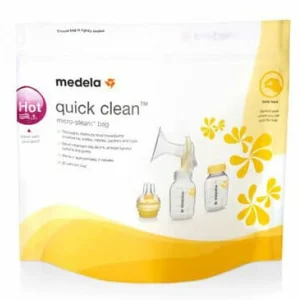
For parents on a budget that won’t allow for a £50 to £80 outlay, or babies who spend time with grandparents, childminders or away on holiday, Medela's reusable Quick Clean Microwave Bags are reliable, compact and surprisingly good value for money.
The box contains five capacious, well-designed bags that can fit two bottles apiece and each bag can be reused 20 times, so they’re much more economical than they might first appear.
Made from tough plastic with a good seal, a cool marked area to hold the bag without burning fingers, and a hole to pour out the water safely before opening, they’re safe and well-designed. The instructions are printed on each bag and there’s also a tick chart so you can keep track of how many times the bag has been used.
The caveat is that you’ll need a microwave to use them, which might not always be available – and, more importantly, sterilising just two bottles at a time won’t be feasible if you’re bottle-feeding full-time.
Good for parents who...
Have a small kitchen
Are on a tight budget that doesn’t allow for large outlays in one go
Need to sterilise every day, but not intensively
Best cold water steriliser
Can easily be scaled up and down for different quantities of equipment and equipment in awkward shapes
Inexpensive to buy and maintain
Items remain sterile for 24 hours and can be added and removed as necessary
The large bucket should be kept out of reach of children when in use and will take up the sink or a reasonable amount of counter space
The sterilisation fluid smells of chlorine – and so will the baby equipment and your kitchen
Key specs
Price: £17 | Capacity: Six bottles, plus breast pump parts | Materials: Plastic | Included: Container and weighted grid
What Mumsnet users say
Tested by Mumsnet: Read our full Milton Cold Water Steriliser review
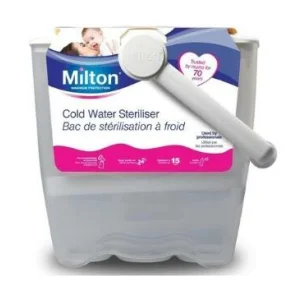
Milton’s cold water sterilising solution has retained its foothold in the market for 70 years. It involves dissolving tablets or fluid into a sturdy five-litre container of water and submerging items in it for 15 minutes as per manufacturer instructions. The bucket comes with a locking lid and a weighted grid to keep items submerged. They’ll remain sterile in the solution for 24 hours and more items can be added as and when they’re used.
There’s a simplicity and low-tech flexibility about the Milton Cold Water Steriliser that lends itself well to scaling up for large piles of gear (using the correct number of tablets in any clean container would also work) – one of the reasons it’s popular on maternity wards and with parents of multiple babies. Just make sure you don’t mind the inevitable swimming pool smell – and keep the large bucket out of reach of children as it’s heavy when full.
Good for parents who...
Have multiple babies, use a lot of bottles per day or want to sterilise a variety of items including breast pumps, toys and dummies
Want a solution that doesn’t affect the energy bill
Best steriliser you can rent
Bebello Washer 4-in-1 Baby Bottle Washer and Steriliser
Uses natural steam to kill 99.9% of germs, no chemicals
Wash cycle finishes in just 19 minutes
Can clean up to eight small bottles or six large (our tester found it easily took four Dr Browns bottles)
No discolouration of bottles after sterilising
Very simple to use
Pricey to purchase
Key specs
Price: £349 to buy, from £38 per month to rent | Capacity: Eight small bottles, six large | Materials: BPA-free plastics, HEPA filter, electrical components | Included: Washer, HEPA filter, drain tube, power cord, 300ml Bebello detergent
What Mumsnet users say
Reviewed by Mumsnet editor Jenny Wonnacott: Read our in-depth Bebello Washer review
If you're looking for an easy to use, planet-friendly bottle washer, steriliser and dryer to rent rather than buy outright, the Bebello Washer is a brilliant choice. Scoring almost full marks across the board with our parent-tester Cath for efficiency, capacity, value for money and ease of use, the Bebello claims to use up to 88% less water than hand-washing.
Holding up to six large bottles or eight small, the Bebello uses natural sterilisation which claims to kill up to 99.9% of germs in a wash cycle of just 19 minutes - though it takes up to 149 minutes for the full wash, sterilise and eco-dry cycle. Our tester Cath loved its time-saving efficiency, user-friendliness and overall performance.
The only slight downside is that you're advised to remove the tank to refill it which can be awkward, particularly when full of 2.5l of water. However, this is easily overcome by simply filling it with a separate jug or bottle.
Best steam steriliser
Tommee Tippee Super-Steam Advanced Electric Steriliser
Takes up very little space on the kitchen counter
Sturdy and safe materials and design
Inexpensive to run
Large capacity
Simple interface to use with rapid sterilisation cycle
Not the most budget-friendly electric steriliser we tested, and a more expensive initial outlay than microwave or travel versions
Doesn’t fit extra-tall bottles, like Dr Brown’s
Doesn’t have any extra features – just a simple sterilisation cycle
Key specs
Price: £50 | Capacity: Approximately six bottles | Materials: BPA-free plastics and metal electrical components | Included: Steriliser and teat tongs – larger sets are also available to buy
What Mumsnet users say
Tested by Mumsnet: Read our full Tommee Tippee Super Steam Advanced Electric Steriliser review
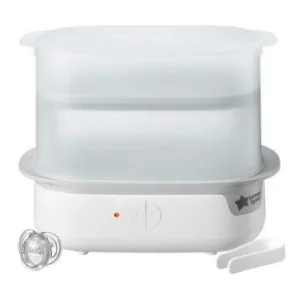
Tommee Tippee has put a great deal of thought into the redesign of their electric steam steriliser and it really shows. The Tommee Tippee Super-Steam Advanced Electric Steriliser is made from tough BPA-free plastics and is exceptionally straightforward to use, with plenty of room for bottles and breast pump parts over two tiers.
It takes one touch of a button to start a cycle and, if you have any accompanying Tommee Tippee bottles, each bottle is clearly marked to show how much water to add to the steriliser – a thoughtful touch that our tester really appreciated.
The sterilisation cycle is just five minutes, one of the shortest from an electric steriliser we tested. If the lid isn’t removed, everything inside stays sterile for 24 hours after running a cycle. While the initial outlay is more than a microwave steriliser, it’s considerably cheaper to run. Altogether, the Tommee Tippee Super-Steam is a reliable, thoughtfully-designed steriliser that’s widely available, well-supported and should do its job consistently over time – a lifesaver to an overloaded new parent and a worthy winner of this year’s Mumsnet Best Steriliser award.
Good for parents who...
Use Tommee Tippee bottles and other Tommee Tippee baby products
Get through up to six bottles a day
Want an electric steam steriliser but don’t have a lot of kitchen workspace available
Read next: The best highchairs for babies and toddlers
Best travel steriliser
Can be stored in a cupboard when not in use
Keeps items sterile for 24 hours
Can be used in the microwave or with cold water sterilising solution
Short two-minute cycle in the microwave or a 15-minute cycle with cold water
Can fit most bottle brands (though not very tall ones, like Dr Brown’s)
It’s not as roomy as the microwave steriliser bags like the ones made by Philips or Medela, which can usually fit two bottles or a bottle and a breast pump – this fits one or the other
When filled with water, it leaks while on its side
The width of the unit means it’s hard to open when wet or very hot
Key specs
Price: £11 | Capacity: One bottle | Materials: BPA-free plastic | Included: Steriliser only
What Mumsnet users say
Tested by Mumsnet: Read our full Milton Solo Steriliser review
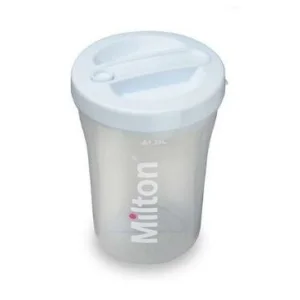
Because travel sterilisers need to be compact enough to carry around, they’re usually short on bells and whistles. What we loved about the Milton Solo was that, travel steriliser or not, it’s more adaptable and comes with more useful design features than any other travel model we tested.
Generously sized for a bottle or breast pump parts, it can be microwaved or used with cold water sterilising solution, whichever works best for where you are. Its width does mean you’ll need both hands to open it though, which can be tricky when it’s hot or wet.
Items inside stay sterile for 24 hours and the lid is designed with a flat lip so it can be laid horizontally in a smaller microwave – a useful feature we didn’t find in any other travel steriliser.
Good for parents who...
Need a steriliser for travel or to live at a grandparent’s or childminder’s house
Want the flexibility of microwave and cold water sterilisation in one unit
Have a small microwave that wouldn’t fit a steriliser upright
Read next: The best baby bath tubs, tried and tested
Best large steriliser
Professional-looking display indicates which stage the cycle is at
Spacious interior for larger bottles
Accessories basket makes it easier to retrieve smaller items
Measuring jug and tongs included
Items inside stay sterile for 24 hours
Eight-minute cycle not the quickest we tested
Short wire limits where it can be placed on the counter
More expensive than some other electric models, like the Tommee Tippee Super-Steam Advanced Electric Steriliser or the Nuby Natural Touch
Key specs
Price: £110 | Capacity: Six bottles | Materials: BPA-free plastics and metal electrical components | Included: Sterilisation unit, measuring jug and tongs
What Mumsnet users say
Similar steriliser reviewed by Mumsnet: Read our full Dr Brown's Deluxe Electric Steam Steriliser review
This is a spacious, professional-looking steriliser with a main compartment for six bottles and a top compartment for smaller items like dummies and teats.
Instructions are clear and easy to follow and the appliance is intuitive to use – three lights on the front let you know instantly whether the eight-minute cycle is heating up, cooling down or completed.
The accessories basket locks shut, which is great for little fingers, and as the Dr Brown’s bottles are the largest on the market, there’s plenty of room inside to sterilise a full day’s worth of bottles at once.
Like any electric steriliser, it attracts limescale on its heating plate so will need regular descaling. If you’re bottle-feeding full-time, however, and need something reliable that will fit in all of your gear, the Dr Brown’s Steriliser is a good choice.
Good for parents who...
Use Dr Brown’s bottles already
Are bottle-feeding full-time or otherwise getting through a lot of equipment per day
Have room on their kitchen counter for a permanent fixture
Read next: The best baby wipes Mumsnetters swear by
Best UV steriliser
Super fast - only takes 3 minutes to sterilise
Chemical and water free - uses UV light to sterilise
You can use it on other items too such as breast pumps and mobile phones
Looks stylish
Bottles need to be dry before you put them in
Does not include any extras such as bottle and dummy
Not recommended for latex items
Key specs
Price: £100 | Capacity: Not specified, reviewers claim two bottles | Materials: Fabric outer | Included: Sterilisation unit, power plug and metal tray
What Mumsnet users say
Brand tested by Mumsnet: Read our full Nuby Natural Touch Steriliser review
Want a steriliser which looks good and can sterilise electric items such as your mobile phone as well as your baby's bottles? Enter the UV steriliser.
While you do need to make sure items are completely dry before popping them in, the UV steriliser is very quick and simple to use, and it looks great too! The capacity isn't quite so large as the likes of Dr Brown's, but thanks to its super speedy run time, the Nuby claims to use less electricity than standard plug-in sterilisers.
Good for parents who...
Want a steriliser which doesn't rely on water
Need a super fast steriliser
Read next: The best baby monitors, tried and tested
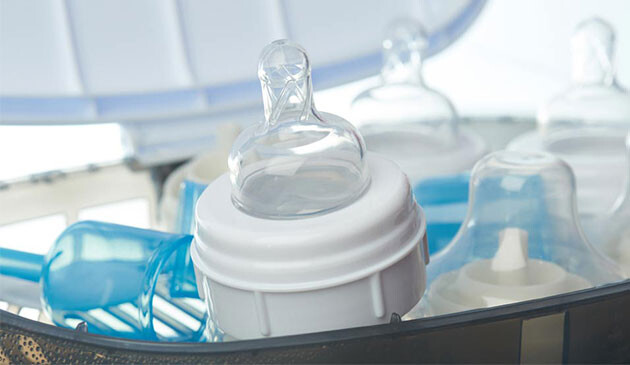
Why do I need a steriliser?
According to the NHS, sterilising feeding equipment is necessary for the first 12 months to keep your baby free from bacteria that could harm their brand-new immune systems. If you’re planning on expressing breast milk, combination feeding or using a dummy during your baby’s first year, you’ll need to sterilise all the relevant baby equipment after every use.
Midwife and antenatal teacher Kate Bennett says, “Babies are particularly vulnerable to infections from bacteria, viruses and fungi in their first year of life as their immune systems are very immature. It’s good practice to reduce the risk of needless germs from feeding equipment in particular as this can make your baby very poorly, including symptoms such as vomiting, diarrhoea and oral thrush.”
What should I use a steriliser for?
As well as baby bottles, teats and breast pump parts, you'll also want to steriliser dummies and teething rings, ideally once a day unless they are dropped on the floor outside.
Baby plates and bowls, cutlery and sippy cups will also need to be sterilised if they’re used before six months but, after that, washing in hot soapy water should be sufficient.
Should you sterilise baby bottles every time?
By the time they’re a year old, your baby’s immune system is much better developed so you can ease off sterilising toys and dummies then.
However, Kate says, “It is always recommended to sterilise your baby’s bottles and teats for as long as you continue using them. This is because milk and milk curds can remain in small amounts in the teat and bottle, and the bugs that feed on them can cause stomach upsets.”
How do I sterilise baby equipment?
The NHS advises that all used equipment – bottles, teats and breast pump parts that come into contact with milk – are cleaned as soon as possible after use using hot soapy water. A bottle brush should be used to clean inside bottles and teats can be turned inside to get into the nooks and crannies.
If you prefer, you can put bottles through the dishwasher (check your breast pump instructions to see which parts are dishwasher-safe, if any) – just make sure bottles, lids and teats are facing downwards, and remember that dishwashing cleans items but doesn’t sterilise them so you’ll still need to do that.
After cleaning, rinse off each item in cold, clean water and then you’re ready to sterilise. Follow the manufacturer’s instructions exactly, especially when positioning items in the steriliser and adding the correct amount of water or sterilisation solution.
After the sterilisation cycle is complete, you can leave the items inside without opening the lid and they’ll remain sterile for a set period of time (often 24 hours, but it varies between products). Or you can take them out and use them once they’re cool.
It’s best to use sterile tongs to handle teats afterwards to prevent contamination, and the majority of sterilisers come with a pair – put the tongs in with the cycle and you know they’re OK to use.
Don’t rinse equipment off again afterwards as the water won’t be sterile. You don’t need to dry them as the cloth likely isn’t sterile either – just shake off the excess moisture and make sure it’s cooled down completely.
When can you stop sterilising baby bottles?
Guidance from the NHS recommends sterilising for at least the first 12 months. After your baby's first birthday, you can start phasing our sterilising as their immune system will be strong enough. However, it's important to continue cleaning all bottles, dummies and other feeding equipment thoroughly even after you've said goodbye to the sterilising tablets.
What are the different types of steriliser?
The type of steriliser that’s right for you will depend on your baby’s routine as well as your environment, so it’s perfectly alright to wait till after the birth – maybe buying a box of sterilisation bags as an interim measure – and assess your sterilising needs in the days and weeks afterwards.
Kate Bennett says, “This is such an individual choice. It depends on what you find easiest, what your budget is and how much space you have. That’s before you think about what you’ll be sterilising and how you plan to feed your baby.”
There are four main sterilisation units on the market: cold water sterilisers, microwave sterilisers, electric sterilisers and travel sterilisers. They all have their own pros and cons.
1. Cold water steriliser
Cold water sterilisers involve filling a container with water and adding sterilisation tablets or fluid to make a sterilisation solution. The active ingredient is sodium hypochlorite, which is a mild bleach that has been through a purification process to make it stable and non-toxic. It’s perfectly safe to use, but does smell vaguely of swimming pool.
The great advantage of cold water sterilisation is its flexibility. The Milton Cold Water Steriliser, for example, is a large five-litre bucket and, with the right number of tablets, an even bigger container could be used, which puts no limit on the amount of equipment you could sterilise at once (great for parents of multiples!).
The items are sterile after a manufacturer-recommended 15-minute cycle – the NHS recommends 30 minutes – and remain so for as long as they’re in the solution. Plus, they don’t need rinsing off when they’re needed. Items can continue to be added and removed as necessary over 24 hours when the solution will need to be remade.
The disadvantages are the smell, the need to continually buy new tablets and the inconvenience of keeping a large container full of water in a corner of your kitchen – especially relevant if you have other small children.
2. Electric steriliser
Electric sterilisers are units set over a heating plate that heats up water and sterilises the contents with steam. They’re usually generously sized, so can handle up to a day’s worth of bottles all at once, and require almost no preparation and no further outlay to use them regularly.
To sterilise, simply add the right amount of water to the heating plate and press a button – it’s quick and easy to do. The sterilisation cycle also tends to be shorter than with cold water sterilisation. The electricity required to run a cycle in one of these will almost always cost less than using a microwave steriliser.
On the downside, the heating plate will almost certainly attract limescale over time so the steriliser will need descaling once or twice a month. You can buy descaling liquid for this, though all steriliser brands now include instructions for natural descaling liquid from store cupboard ingredients which is a more eco-friendly option. Electric sterilisers are also the most expensive to buy.
3. Microwave steriliser
Microwave sterilisers also use steam to sterilise their contents, which may appeal to you if you prefer to sterilise without chemicals.
They are essentially a large, round, plastic box with a screw-on lid, usually with an internal basket to hold the bottles. Water is poured into the bottom (under the basket) and in the microwave it boils to create steam.
The advantage of microwave sterilisers is that they’re more capacious than travel models but smaller than electric ones, so they can be stored out of sight. The length of the cycle is almost always shorter than using an electric steriliser, too, which might come in handy with a very hungry baby.
Usually, they’re of a size that isn’t truly portable, however, and you still might find it inconvenient to find the cupboard space or take it with you to a grandparent’s house. Some of the larger models might not fit inside more compact modern microwaves either.
Plus, they’re usually more expensive to run than electric sterilisers as they have a smaller capacity (so you’ll be running more cycles) and microwaves ultimately use more energy.
4. Travel steriliser
Babies still need feeding on holiday (who knew?) so travel sterilisers are designed to provide a portable solution that works on the go.
Most of them are cup-shaped microwave sterilisers large enough for one bottle or one breast pump – though you might not always have access to a microwave when away from home so look out for ones that can be used with cold water solution as well.
Microwave steriliser bags have also become more popular in the last few years. These are reusable pouches made from a tough plastic and work by sealing baby equipment in the pouch with some water and microwaving for a set time. These tend to be more roomy than the cup model, with the best fitting two bottles in at a time, and able to be reused around 20 times per bag.
If you’re using bottles and breast pumps regularly but not intensively, you might find that a travel steriliser is sufficient for your needs – it’s certainly cheaper to buy and easier to throw into a drawer. If you’re bottle-feeding full-time, though, sterilising one or two bottles at a time will be too inefficient and labour-intensive to manage.
5. UV steriliser
Relatively new to the steriliser market are UV sterilisers, which use UV light to kill bacteria. Their versatility means that you can use them to pretty much sterilise anything, including mobile phones and keys, however some UV sterilisers may not be suitable for sterilising natural rubber and latex (think certain dummies and the ever-popular Sophie La Girafe).
While they tend to take longer to sterilise things than a steam steriliser, the advantage of a UV steriliser is that you don't have to contend with equipment that's hot to the touch after sterilisation, making them a safer option for most households. You also won't need to do any descaling after use.
What makes a steriliser safe?
Electric sterilisers sold in the EU should have the CE marking somewhere on the box or instructions. This indicates that the steriliser complies with relevant EU legislation on health, safety and environment standards.
Plastic used in any steriliser part should be BPA-free – the manufacturer almost always declares this on their website, but if they don’t you can follow up with their customer service department.
Electric, microwave and travel sterilisers using steam will all get very hot, so the usual cautions apply: wait the recommended amount of time before opening the lid after a cycle has completed, open the lid away from you to redirect any steam, use oven gloves to retrieve from the microwave if necessary, and of course keep any hot items away from children.
For cold water sterilisers, a full container will be very heavy and should be kept away from children so they can’t pull it over onto their head. Sterilisation fluid is made from sodium hypochlorite, a mild, non-toxic bleach that decomposes into water and a small amount of salt.
If sterilisation fluid is accidentally ingested by a child, Milton advise: “Because of the salt in the solution in the bottle, the child will usually spit the fluid out, or, at worst, be sick. If they are not sick, there should be no need to worry but a concerned parent can give the child a drink of milk. Because milk is a protein, it will neutralise the Milton solution. The Milton Sterilising Fluid should be neutralised by the saliva proteins and break down into salt and water. However, it is always best to seek medical advice or contact your GP to ensure complete safety."
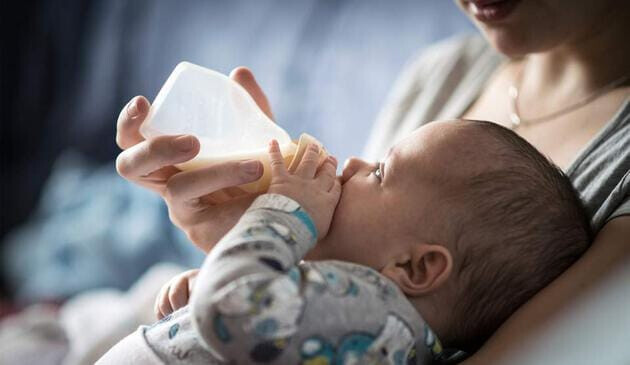
How do I choose a steriliser?
1. Capacity
If you’re bottle-feeding or expressing full-time, you’re likely to get through a large pile of equipment in a 24-hour period and you don’t want to spend all of it refilling the steriliser.
If you mostly breastfeed and give an expressed bottle on occasions, your needs will be different. Sterilising no more than once or twice in 24 hours is ideal, so look for the stated bottle capacity and see whether it matches your expected daily use. Don’t forget to measure your microwave before buying a microwave steriliser to check it will fit.
2. Storage requirements
Do you have enough kitchen counter space to keep a sterilising unit out all the time? Would you want to if you did? Electric units usually stay plugged in on the counter – they’re too large to store and too bulky for it to be convenient to move them often.
Microwave sterilisers are smaller, but not exactly portable. They could sit on top of the fridge or stay in the microwave itself if you’d rather not keep them out.
3. Cycle time
The length of a sterilisation cycle varies wildly between brands. If you’ve got a set-up where you intend to batch-sterilise once a day, a longer cycle won’t matter so much. But if you’re planning on sterilising more often, you won’t want to wait by the steriliser juggling a hungry baby.
4. Noise
This only applies to electric sterilisers but is worth bearing in mind nonetheless. Several make loud beeps at the beginning and end of their cycle and some even during, making a dishwasher-like hum.
The beeping especially might be inconvenient with a sleeping baby in the house so you may want to check that before you buy.
How do I descale and clean a steriliser?
Electric sterilisers attract limescale on their heating plate over time so will need regularly descaling (manufacturers will specify a frequency, but it’s usually once or twice a month). To reduce limescale build-up, pour out the water after every use and wipe down with a soft damp cloth.
To descale, you’ll need descaling solution which you can easily buy in supermarkets – though most brands now give instructions for an eco-friendly version using vinegar. Pour in the solution over the heating plate and leave to soak for between 30 minutes and 24 hours, depending on the extent of the limescale. Pour out, rinse with cool water, wipe with a damp cloth, then run an empty cycle before using the steriliser as normal.
Microwave, travel and cold water sterilisers can be cleaned with hot soapy water as needed, and many can also go in the dishwasher (check the manufacturer’s instructions first). It’s not necessary to run an empty cycle after washing.
How much do sterilisers cost?
Electric sterilisers are unsurprisingly the most expensive. The cheapest starts at about £40 and they go all the way up to around £90, depending on the functionalities. They use less electricity than microwaves and should cost you around 25p a month in energy bills.
Microwave sterilisers vary wildly from around £12 to £40 – the more expensive ones will likely have small extra features like lockable lids or more robust plastic, but there’s not much variation in style regardless of price.
The bestselling cold water steriliser is Milton’s, at £18, but the point of cold water sterilisation is that it can be done in any container of any size. You’ll always have the ongoing expense of sterilisation tablets, though these shouldn’t set you back more than £1.50 or so a month.
Being much smaller, travel sterilisers are less expensive, retailing at about £10 for a cup-style model or a box of five sterilising bags. As their capacity is so much smaller, this will only be a long-term saving if you’re not using lots of equipment daily.
How we tested and chose our recommendations
We commissioned Rachel Jeffcoat, a writer and mum of three, to research and review the top sterilisers out there. As a parent to an eight-, six- and two-year-old, all of whom were combination-fed as babies, Rachel has years of experience using a wide variety of baby equipment, including sterilisers. As a writer, she’s written extensively on parenthood, including Mumsnet’s reviews on the best baby sleeping bags and the best baby bottles.
Rachel spent 10 hours researching the current steriliser market. She looked into the different sterilisation modes and scoured the market for cutting-edge new products as well as old established favourites. She read scores of user reviews, including those in the Mumsnet forums, and collated Amazon and Which? bestsellers.
She investigated best practice safety recommendations from the NHS and sourced expert advice from Kate Bennett, a midwife of nine years and course teacher with antenatal education provider, New Life Classes.
Finally, she narrowed down her list of choices to 14 testing candidates from a mixture of sterilisation categories, brands and price points.
A selection of the above sterilisers were put through their paces with various parent testers over a period of several months, during which time they were assessed carefully for a number of important considerations including efficiency, ease of use and overall value for money.
Why you should trust our reviews
All Mumsnet product reviews are written by real parents. We work hard to provide honest and independent advice you can trust – brands can’t pay to be featured in our articles or win a Mumsnet Best award.
We spend hours researching, speaking to parents, analysing data and listening to experts before we test out the products on our shortlist.
Transparency is really important to us and that's why we're always upfront about how we tested the products we recommend. We won't always recommend the cheapest products or the ones with the most extra features. We write about products that we feel offer the best value to most parents – the ones we'd recommend to our own friends and family.
There's no incentive for us to be lazy with our research or in our testing process. There's no reason for us to respond to pressure from retailers or brands trying to promote new products. It's actually quite the opposite and we think it's a good system, one that keeps us focused on making parents lives' easier.
About the author
Rachel Jeffcoat has worked for 15 years as an editor and writer, after starting her career managing science and technology journals.
She now writes and edits for businesses, including some in the nursery retail sector, and has worked with the Mumsnet Reviews team for several years. She has also had essays and poetry published in Huff Post, Fourth Trimester Magazine and Dear Damsels. She has three small children.